


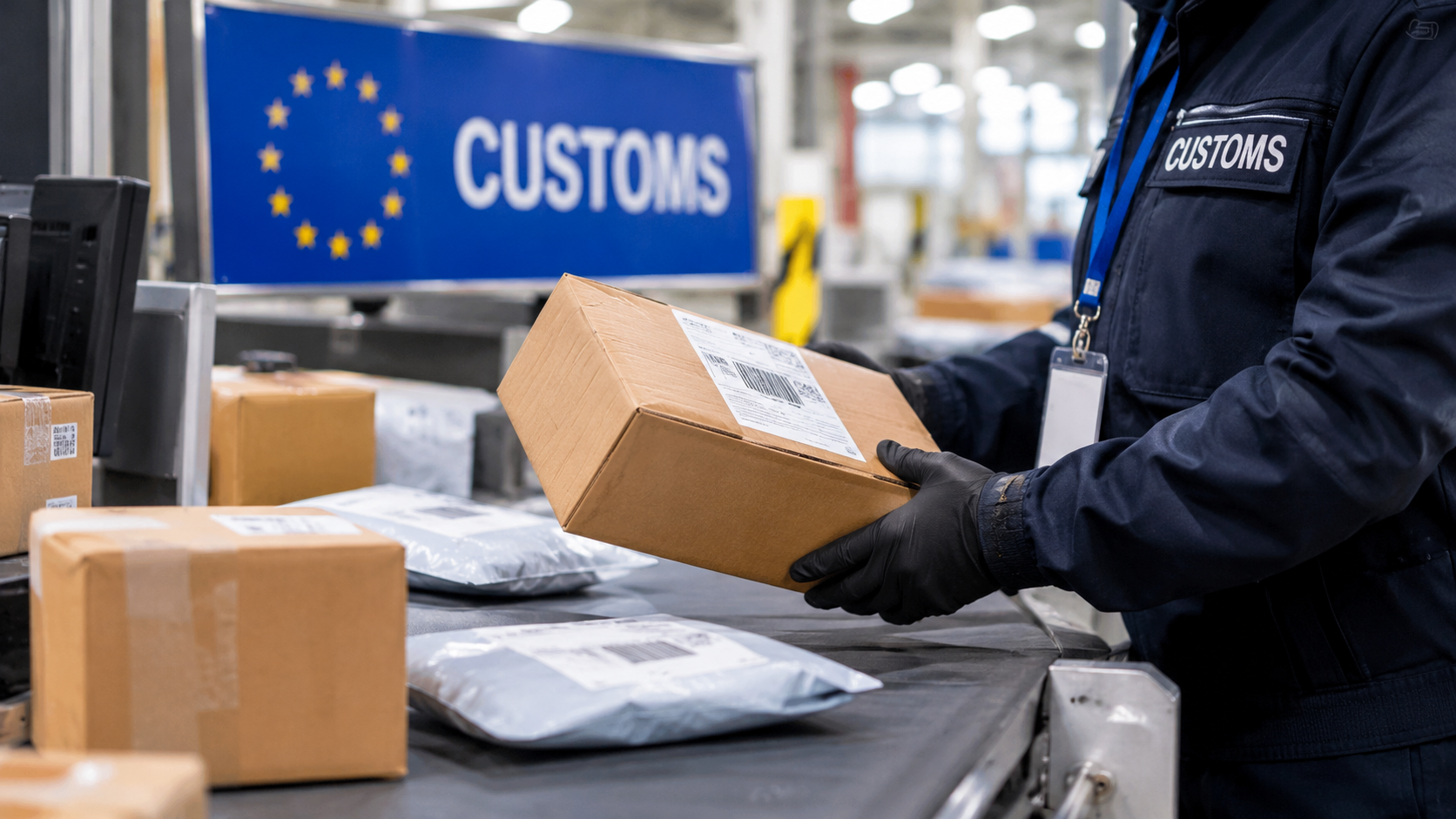
EU Union handling fee: what non-EU online sellers need to know
18 November 2026| CATEGORIES: EU customs reform, EU Union handling fee, EU VAT, import VAT, IOSS| TAGS: Customs reform, EU, import VAT, IOSS, non-EU sellers
Since 1 November 2026, a new €2 Union handling fee has applied to goods sold online to EU consumers and imported from outside the EU.
The fee is charged on top of the temporary €3 customs duty that has applied to low-value consignments since 1 July 2026. Unlike the €3 duty, it applies whatever the value of the consignment.
For non-EU sellers, the additional cost can squeeze margins, complicate checkout pricing and create new VAT reporting challenges.
Importantly, the European Commission has also changed its view on the VAT treatment of the fee. Having previously said that no VAT was due on it, the Commission now considers that the fee forms part of the taxable amount for VAT.
With the fee now in force, businesses selling to EU consumers should check how it is being applied to their customs declarations, customer charges and VAT returns, and ensure that the necessary product and customs data is available.
Background: a major reform of EU customs
The EU has adopted Regulation (EU) 2026/2108, which establishes a new Union Customs Code and a new European Union Customs Authority. It will progressively replace the existing Union Customs Code as part of a wider reform designed to strengthen customs supervision and address the growth in e-commerce imports.
The reform places greater responsibility for customs formalities, duty payments and compliance on the businesses involved in online sales, including sellers and online platforms. These changes are being introduced in phases.
Two charges are particularly relevant to businesses selling goods from outside the EU to EU consumers.
What is the temporary €3 customs duty?
From 1 July 2026, the €150 customs duty exemption for low-value consignments was abolished. A temporary €3 customs duty now applies to distance sales of imported goods in consignments not exceeding €150.
The duty is charged per item rather than per parcel, and applies whether the goods are imported using the Import One Stop Shop (IOSS), the special arrangements for import VAT or the standard import procedure. It is due to run until 30 June 2028.
The European Commission’s guidance on the €3 customs duty and Union handling fee explains how the duty and handling fee operate in practice.
What is the Union handling fee?
The new Union Customs Code introduces a Union handling fee to cover the work customs authorities carry out when goods sold in distance sales are released into free circulation.
The amount was set by Commission Delegated Regulation (EU) 2026/2152, published on 22 October 2026, at €2 per item. The fee has applied since 1 November 2026 and is currently payable by the person who makes the customs declaration.
The fee is separate from the €3 customs duty and applies to all qualifying distance sales, whatever the value of the consignment. Goods exceeding €150 may therefore be subject to the handling fee as well as normal customs duty and import VAT.
The fee is intended to cover the cost of customs supervision, including data checks, risk analysis and controls. A lower fee will apply from 1 July 2028 to goods sold in distance sales and released from a customs warehouse, although the amount has not yet been set.
The fee cannot be refunded once the customs declaration has been accepted, even if the goods are later returned or not released. However, any import VAT charged on the fee may be refunded with the rest of the import VAT if the goods are returned.
How is an “item” counted?
The new Union Customs Code defines an item as one or more goods in a consignment that share certain data, including the same tariff classification and origin.
In practice, the Commission’s guidance explains that customs systems apply the €3 duty and €2 fee to each line of the customs declaration, however many goods are on that line. Goods with different tariff classifications, descriptions or origins may therefore be declared on separate lines and attract separate charges.
Businesses should review their customs declaration processes and product data to ensure that goods are classified, described and grouped correctly.
How are the charges treated for VAT?
The VAT treatment depends on the import procedure used and, for IOSS sales, whether the relevant charge is passed on to the customer at the time of sale.
The Commission’s current view is set out in its revised VAT guidance dated 6 October 2026. This reverses its earlier guidance, which said that the handling fee was outside the scope of VAT, so commentary published before October 2026 may be out of date. The table below summarises the current position.
| Charge | IOSS | Special arrangements | Standard import |
| €3 customs duty | Excluded from the IOSS taxable amount if due only on import; included if charged to the customer at the point of sale. | Included in the import VAT taxable amount. VAT on the duty is refunded if the goods are returned. | Due on qualifying consignments not exceeding €150 and included in the import VAT taxable amount. VAT on the duty is refunded if the goods are returned. |
| €2 handling fee | No import VAT on the fee at importation. Included in the IOSS taxable amount if charged to the customer at the point of sale. | Included in the import VAT taxable amount. VAT on the fee is refunded if the goods are returned. | Included in the import VAT taxable amount. VAT on the fee is refunded if the goods are returned. |
For consignments exceeding €150, the temporary €3 duty does not apply. Instead, the normal customs duty rules apply, alongside import VAT and the €2 Union handling fee. Under the standard import procedure, the handling fee must be included in the import VAT taxable amount.
What this means for sellers using IOSS
IOSS allows eligible sellers and online marketplaces to collect VAT on qualifying low-value distance sales at the point of sale, with the VAT reported through the IOSS return.
The Commission considers that the €3 customs duty should not be included in the IOSS taxable amount where it only becomes due when the customs declaration is accepted, after the sale has taken place. However, where the duty is charged to the customer at the time of sale, it forms part of the consideration for the supply and must be included in the IOSS taxable amount.
For the handling fee, the Commission’s position is that it must be included in the IOSS taxable amount where it is charged to the customer at the time of sale. There is no import VAT on the fee at the point of importation where IOSS is used.
Businesses should therefore distinguish between customs charges due on import and amounts collected from customers at the time of sale. Pricing, checkout processes and IOSS reporting should reflect that distinction.
VAT on the handling fee under the import procedures
The Commission considers the handling fee to be an incidental expense of the supply, so that it forms part of the taxable amount for VAT. As the Commission’s position has already changed once, businesses should keep it under review.
Accordingly, where import VAT is due under the special arrangements or the standard import procedure, the handling fee must be included in the taxable amount on which import VAT is calculated.
Where a seller recharges the handling fee to its customer, it should not assume that the recharge is a VAT-free disbursement. Where the seller is liable for the fee as declarant, the recharge will normally form part of the price of the goods and should be treated in the same way for VAT.
Should sellers pass the fee on to customers?
Sellers can choose whether to recharge the €2 handling fee to their customers. If they do not, they will need to absorb the cost, which will reduce their margin. For low-value goods, the handling fee and the €3 customs duty together can be a significant proportion of the selling price.
Sellers using IOSS should take particular care with goods priced at or close to €150. IOSS can only be used for consignments with an intrinsic value not exceeding €150. Intrinsic value is broadly the price of the goods themselves and excludes other charges that are shown separately. If the handling fee is built into the price of the goods, it could take the consignment over €150. The sale would then fall outside IOSS, and import VAT would be due when the goods enter the EU instead of being accounted for through the IOSS return.
Where the fee is recharged, showing it as a separate charge on the order confirmation and invoice should keep it out of the €150 calculation. However, the Commission has not addressed this point specifically. The recharged fee will still form part of the taxable amount for VAT declared in the IOSS return. Sellers should check that their checkout systems test the €150 limit against the correct value.
Additional customs data requirements
From 1 November 2026, product identifiers must also be provided to customs for relevant distance-sale goods in consignments with an intrinsic value not exceeding €150. This requirement is intended to improve product traceability and help customs authorities identify non-compliant goods.
Businesses should confirm with their customs representatives and logistics providers which product identifiers are required, how the information will be collected and transmitted, and whether their product data systems are ready to support the requirement.
What should businesses do now?
Non-EU sellers and online marketplaces should:
- Check the first declarations. Confirm that the €2 handling fee and, where applicable, the €3 customs duty are being calculated correctly and that the number of declaration lines is consistent with the goods and supporting data.
- Confirm who is responsible for payment. Review arrangements with marketplaces, carriers and customs representatives to establish who is acting as declarant, who is liable for the charges and how the costs will be recovered.
- Review pricing and margins. Decide whether to absorb the handling fee or pass it on to customers, and assess the combined effect of the handling fee, the temporary customs duty on qualifying consignments and any applicable customs duty and import VAT.
- Check product data. Ensure product classifications, descriptions and origin information support the correct customs declaration treatment and calculation of the charges.
- Implement product identifier requirements. Confirm that the required product identifiers are available and are being provided to customs for relevant consignments not exceeding €150.
- Review VAT treatment and reporting. Check how the charges are reflected in checkout pricing, customer invoices, import VAT calculations and VAT returns. Businesses using IOSS should ensure that amounts charged to customers at the time of sale are included in the IOSS taxable amount where required.
- Plan for the wider customs reform. Assess how the phased changes to the responsibilities of online platforms and sellers will affect supply chains, customs representation and compliance processes.
Higher costs for non-EU sellers
The handling fee and the €3 duty together add a significant cost to each item sold into the EU, and the Commission’s revised VAT guidance increases that cost further where import VAT is due. Sellers should check now that the charges are being calculated correctly and reflected properly in their pricing and VAT reporting.
How RBC VAT can help
RBC VAT advises businesses on UK and EU VAT compliance, including cross-border e-commerce, IOSS, marketplace arrangements and the VAT implications of customs changes.
We can help businesses assess the impact of the new charges, review pricing and contractual arrangements, and check the VAT treatment of customer charges and reporting under IOSS and the other import procedures.